
- Home
- Food & Beverage
- Pasta Market
Pasta Market Report- Global Strategic Analysis, Size, Share, Trend, and Forecast (2025-2035)

Market Overview
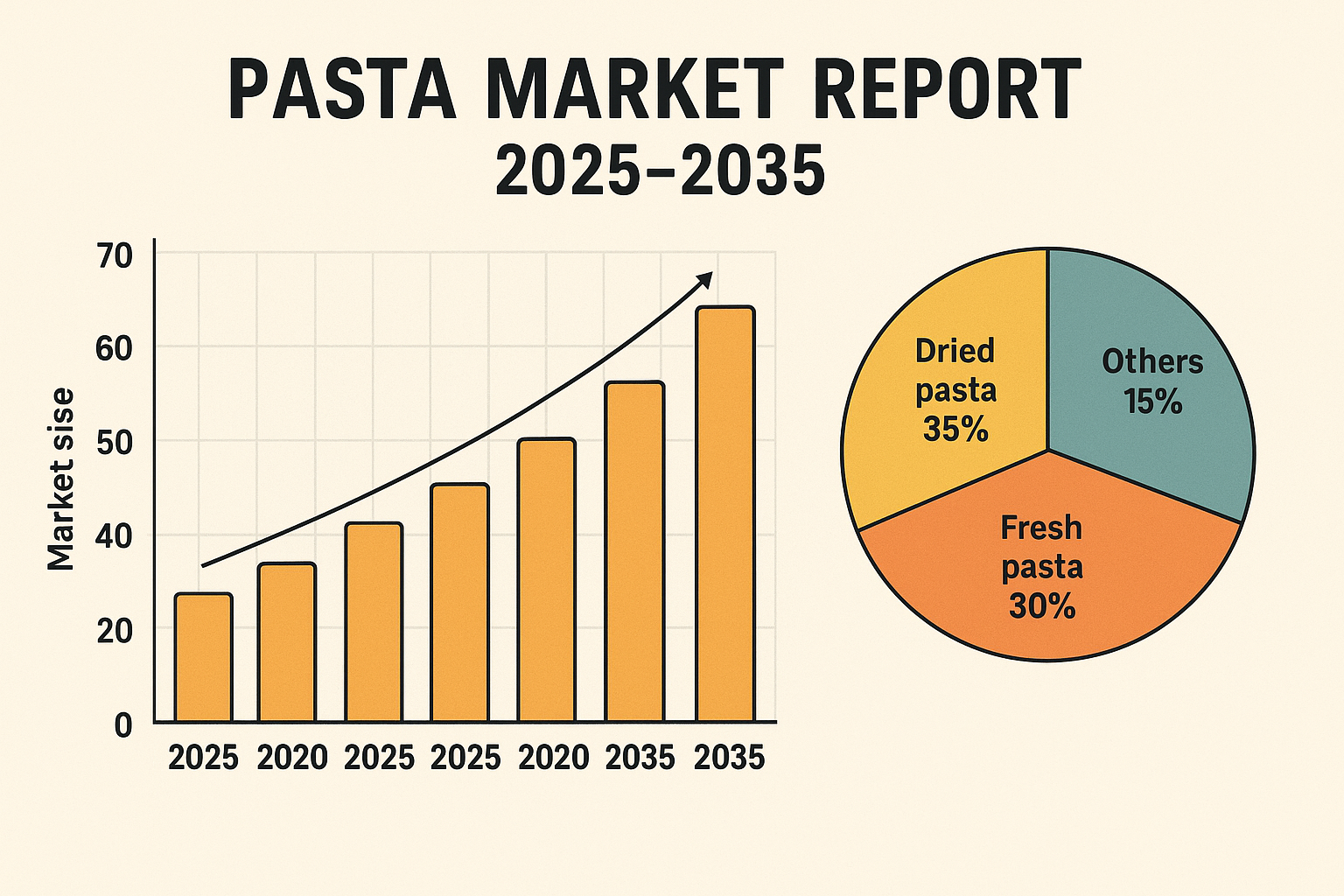
The global pasta market is projected to grow significantly, reaching a market value of USD 128.88 billion by 2035, with a Compound Annual Growth Rate (CAGR) of 5.4% during the forecast period (2025–2035). This growth is driven by increasing consumer demand for convenient, versatile, and innovative pasta products, alongside evolving dietary preferences and global culinary trends.
Market Size and Share
-
Market Size: The global pasta market was valued at USD 72.50 billion in 2024 and is expected to reach USD 128.88 billion by 2035, driven by a CAGR of 5.4%.
-
Market Share by Segment:
-
Dried Pasta: Expected to dominate, reaching USD 39.1 billion by 2030 with a CAGR of 3.8%, reflecting its popularity due to long shelf life and affordability.
-
Chilled/Fresh Pasta: Anticipated to grow at a CAGR of 2.8% through 2030, appealing to consumers seeking premium and fresh options.
-
Instant Pasta: Holds a significant share, driven by demand for quick meal solutions, with a 48.4% market share in 2021.
-
Other Types: Includes canned/preserved pasta and niche products like gluten-free and plant-based varieties, gaining traction due to dietary trends.
-
Growth Drivers
-
Convenience and Busy Lifestyles: Increasing demand for quick-to-prepare meals aligns with pasta’s versatility, driving sales of instant and dried pasta.
-
Health-Conscious Consumer Trends: Growing preference for whole grain, gluten-free, and protein-enriched pasta varieties caters to dietary needs.
-
Innovation in Product Offerings: Introduction of alternative flours (e.g., chickpea, lentil, quinoa) and organic/artisanal pasta meets consumer demand for premium and sustainable products.
-
Globalization of Cuisines: Rising popularity of international cuisines, particularly Italian, boosts demand for diverse pasta shapes and flavors.
-
E-commerce Expansion: Growth in online retail channels, including subscription-based and direct-to-consumer models, enhances accessibility.
-
Pandemic-Induced Home Cooking: Increased home cooking and stockpiling of non-perishable foods like pasta have sustained market growth.
-
Sustainability and Organic Trends: Emphasis on eco-friendly packaging and organic ingredients appeals to environmentally conscious consumers.
Market Trends
-
Plant-Based and Gluten-Free Options: Rising demand for pasta made from alternative ingredients like lentils and chickpeas due to health and environmental concerns.
-
Premiumization: Growth in artisanal and organic pasta products, emphasizing high-quality ingredients and traditional methods.
-
Ethnic and Regional Flavors: Increasing consumer interest in authentic and diverse pasta flavors inspired by global cuisines.
-
Technological Advancements: Improved food processing enhances the quality and texture of non-traditional pasta, expanding market reach.
-
E-commerce Growth: Online platforms like Amazon and Eataly facilitate access to a wide range of pasta products, with online channels projected to grow at a CAGR of 5.4%.
-
Health and Wellness: Demand for fortified and enriched pasta with higher protein and fiber content is rising.
Key Players
Major companies in the global pasta market include:
-
Barilla G. e R. Fratelli S.p.A
-
De Cecco di Filippo S.p.A
-
Ebro Foods S.A
-
Nestlé S.A
-
The Kraft Heinz Company
-
Campbell Soup Company
-
Unilever PLC
-
Conagra Brands, Inc.
-
Toyo Suisan Kaisha, Ltd.
-
Nissin Foods Holdings Co., Ltd.
These players focus on product innovation, sustainable practices, and expanding distribution channels to maintain competitive advantage.
Strategic Analysis
-
Opportunities:
-
Expanding into emerging markets with growing middle-class populations adopting Western dining habits.
-
Leveraging e-commerce and subscription models to reach new consumers.
-
Developing innovative products like gluten-free and plant-based pasta to capture health-conscious segments.
-
-
Challenges:
-
Competition from other convenient food options like fast food and frozen meals.
-
Rising raw material costs, particularly wheat, due to supply chain disruptions.
-
Consumer skepticism about processed foods impacting demand for traditional pasta.
-
Conclusion
The global pasta market is poised for robust growth through 2035, driven by consumer demand for convenience, health-focused products, and innovative offerings. Key players are capitalizing on these trends through product diversification and expanded distribution channels, particularly e-commerce. However, challenges such as competition and rising raw material costs require strategic adaptation to sustain growth.
Table of Content
1. Market Overview
1.1 Research Methodology
1.2 Definitions and Scope
2.Market - Executive Summary
2.1 Market Opportunity
2.2 Key Trends by Product Segments
2.3 Key Trends by Geography
3. Pasta Market Landscape
3.1 Comparative analysis
3.1.1 Product Benchmarking - Top 10 companies
3.1.2 Top 5 Financials Analysis
3.1.3 Market Value split by Top 10 companies
3.1.4 Pricing Analysis
4. Market Forces
4.1 Market Drivers
4.2 Market Constraints
4.3 Market Challenges
4.4 Porter’s Five Forces
4.4.1 Bargaining Power of Suppliers
4.4.2 Bargaining Power of Consumers
4.4.3 Threat of New Entrants
4.4.4 Threat of Substitute Products and Services
4.4.5 Degree of Competition
5. Pasta Market - Strategic Analysis
5.1 Value Chain
5.2 Opportunity
5.3 Patent Analysis
6. Global Pasta Market Outlook
6.1 Global Pasta Market Outlook, by Type, 2025-2035
6.2 Global Pasta Market Outlook, by Application, 2025-2035
7. Asia Pacific Pasta Market Outlook
7.1 Key Snapshot
7.2 Asia Pacific Pasta Market Outlook, by Type, 2025-2035
7.3 Asia Pacific Pasta Market Outlook, by Application, 2025-2035
7.4 Asia Pacific Pasta Market Outlook, by Country, 2025-2035
8. North America Pasta Market Outlook
8.1 Key Snapshot
8.2 North America Pasta Market Outlook, by Type, 2025-2035
8.3 North America Pasta Market Outlook, by Application, 2025-2035
8.4 North America Pasta Market Outlook, by Country, 2025-2035
9. Europe Pasta Market Outlook
9.1 Key Snapshot
9.2 Europe Pasta Market Outlook, by Type, 2025-2035
9.3 Europe Pasta Market Outlook, by Application, 2025-2035
9.4 Europe Pasta Market Outlook, by Country, 2025-2035
10. Latin America Pasta Market Outlook
10.1 Key Snapshot
10.2 Latin America Pasta Market Outlook, by Type, 2025-2035
10.3 Latin America Pasta Market Outlook, by Application, 2025-2035
10.4 Latin America Pasta Market Outlook, by Country, 2025-2035
11. Middle East and Africa Pasta Market Outlook
11.1 Key Snapshot
11.2 Middle East and Africa Pasta Market Outlook, by Type, 2025-2035
11.3 Middle East and Africa Pasta Market Outlook, by Application, 2025-2035
11.4 Middle East and Africa Pasta Market Outlook, by Country, 2025-2035
12. Pasta Market -Entropy
12.1 New Product Launches
12.2 M&A, Collaborations, JVs, and Partnerships
13. Pasta Market Company Analysis
13.1 Market Share Analysis, Financial Analysis, Product Synopsis, Recent News and Developments
13.2 Company 1
13.3 Company 2
13.4 Company 3
13.5 Company 4
13.6 Company 5
13.7 Company 6
13.8 Company 7
13.9 Company 8
13.10 Company 9
13.11 Company 10
Related Reports
-
Organic Beer Market Report- Global Strategic Analysis, Size, Share, Trend, and Forecast (2025-2035)
- Published: July, 2025
- Price: $2950
- Sample Request
-
Tea Bags Market Report- Global Strategic Analysis, Size, Share, Trend, and Forecast (2025-2035)
- Published: July, 2025
- Price: $2950
- Sample Request
-
Processed Fruit Market Report- Global Strategic Analysis, Size, Share, Trend, and Forecast (2025-2035)
- Published: July, 2025
- Price: $2950
- Sample Request
-
Industrial Enzymes Market Report- Global Strategic Analysis, Size, Share, Trend, and Forecast (2025-2035)
- Published: July, 2025
- Price: $2950
- Sample Request